

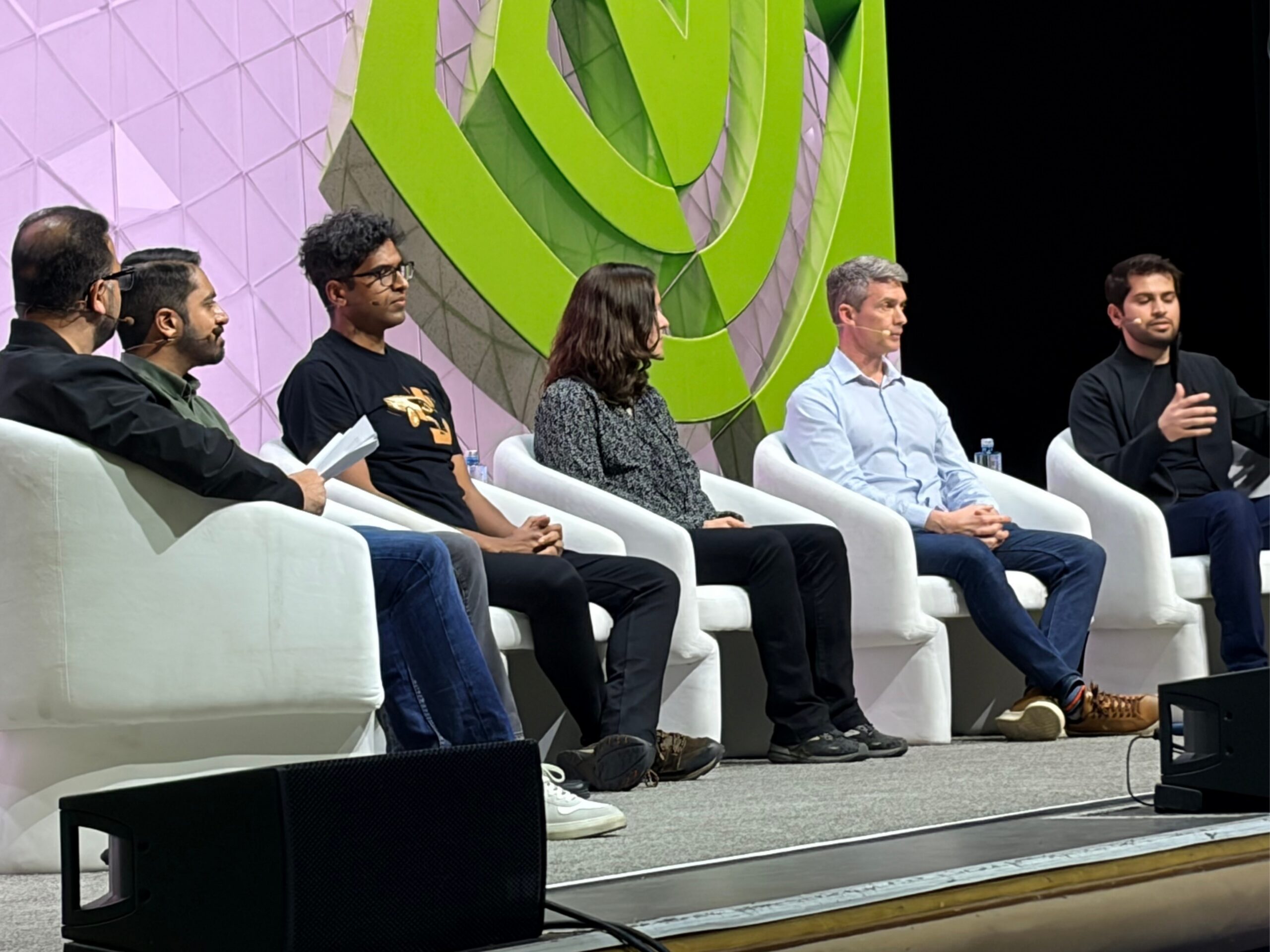

At NVIDIA GTC 2026, Amit Goel, Head of Robotics and Edge Computing Ecosystem at NVIDIA, brought together leaders from Agility Robotics, Tesla, Physical Intelligence, Hexagon Robotics, and Skild AI around the “From Concept to Production: Humanoid Robotics at Scale” topic.
The discussion focused on one of the defining questions in robotics today: what does it take to move humanoid robots from prototypes and demonstrations toward real-world deployment?
Recent humanoid robot demonstrations have shown strong progress in motion, manipulation, dexterity, and autonomy. However, industrial production environments introduce a new level of complexity: humanoids must perform reliably over time, adapt to variable environments, interact safely with people, and integrate into existing workflows.
The panel explored the technical foundations behind the concept-to-production shift: useful data, simulation grounded in reality, model orchestration, continuous learning, and the ability to connect robotic intelligence to real industrial environments.
Useful data matters more than more data
Data is key to achieving this milestone. The panel explored how robotics teams are collecting data through different sources, including teleoperation, and robot demonstrations, as well as human video, 3D factory capture for simulation, and real-world deployment data.
The challenge is not only to collect more data. But to collect the right one.
For humanoids to operate reliably, data must be useful and connected to real tasks and real environments. Robots need to learn not only how a task is performed, but also what matters around that task: the workspace, the tools, the objects, the people, the interference, and the variation that can affect execution.
In industrial environments, this context is critical. A robot does not operate in isolation. It integrates into a production system.
Simulation must be grounded in reality
Simulation was another central topic. Panellists discussed how simulation can support training, testing, policy evaluation, and system validation before humanoids operate in the real world. At the same time, the panel made clear that simulation must remain grounded in the real world. To be useful, virtual environments in simulation need to reflect the conditions robots will face outside the lab. This includes variation in tasks, surroundings, objects, and human activity. Real-world data is needed to measure and reduce the sim-to-real gap. Essentially, this means making virtual environments look and feel the same as the real world.
For Hexagon Robotics, this connects directly to the company’s work with reality capture, digital twins, and accurate environmental data. Arnaud Robert explained that understanding the full environment around a task is critical, not only the task itself. Capturing a complete view of the environment can help identify what is part of the task, what is interference, and what needs to be included in training for the robot to perform reliably.
From automation to autonomy
The discussion also addressed model architectures and the emerging technical stack for physical AI. Panellists explored foundation models, world models, control systems, system hierarchy, and the different ways robotics companies are connecting high-level intelligence with physical execution.
For humanoids, this connection is complex. Perception, planning, locomotion, manipulation, sensing, and control operate at different speeds and levels of precision, requiring the system to coordinate the right capabilities for each task and environment.
Hexagon Robotics’ perspective focused on practical industrial deployment. Arnaud Robert described an approach that combines different models and system capabilities for different needs, from high-precision tasks using modular end-effectors to faster locomotion, with orchestration helping select the right model for the situation.
Scaling requires continuous learning
The path to deploying humanoids at scale also raises questions about long-term operation. Robots will need to operate persistently in real environments, improve over time, and learn from deployment.
This creates new requirements for reliability, safety, validation, infrastructure, and continuous learning.
For Hexagon Robotics, one important direction is fleet learning. As more robots operate in industrial environments, lessons from one AEON could help improve the performance of others in the same fleet.
This is an important part of scaling. The goal is not to build individual humanoids capable of performing tasks. It is to integrate systems that can learn, improve, and deliver value across real industrial operations.
The path to production
Moving humanoid robotics from concept to production is not only a question of building more capable robots. It requires useful data, realistic simulation, reliable control, accurate spatial understanding, model orchestration, and continuous learning in real environments. The path to scale depends on connecting these elements into systems that can be tested, improved, and deployed for practical industrial work.
For Hexagon Robotics, the path is grounded in industrial reality: understanding the environment, connecting data to physical execution, and building humanoid systems that can support practical work in production environments.
Watch the full NVIDIA GTC 2026 panel to hear how industry leaders are approaching the next phase of physical AI and humanoid robotics at scale.