
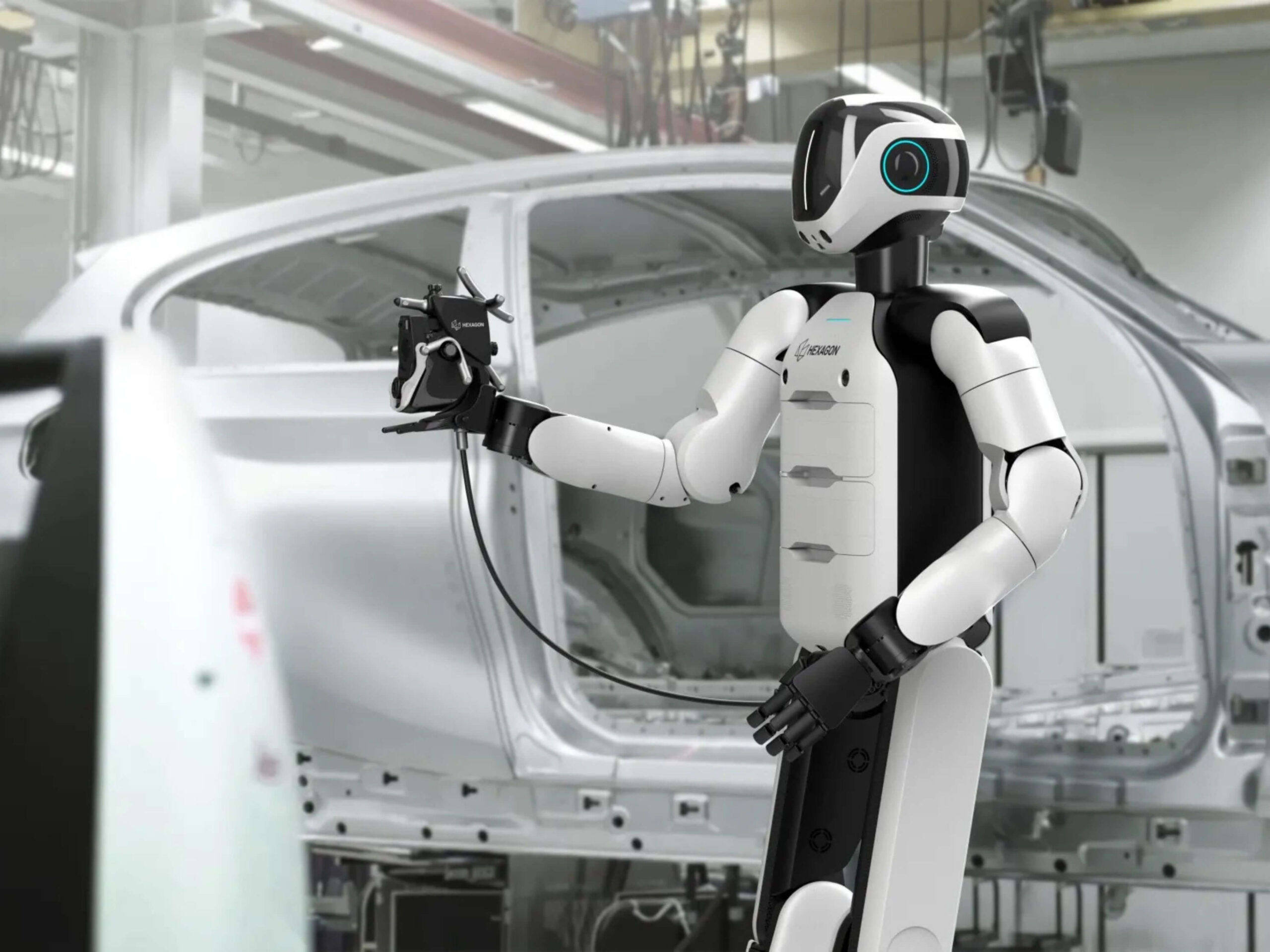

Bloomberg recently examined how humanoid robots offer Europe a path to strengthen its position in the global technology race.
The piece looks at this opportunity through the lens of industrial expertise, automotive suppliers, robotics companies, and early customer deployments, including Hexagon Robotics’ work with AEON alongside activity from companies such as Neura Robotics, Schaeffler, and Bosch.
For Hexagon Robotics, the feature reflects a broader shift already underway: humanoid robotics is moving from ambition toward industrial execution
An industrial race
Humanoid robotics is gaining momentum through manufacturing interest, advances in AI-powered robots and autonomous machines and heavy investment.
As the market develops, the focus is shifting from what humanoids can demonstrate to what they can repeat reliably. For industrial customers, the question is not only whether a robot can perform a task once, but whether it can do so consistently in real production environments.
The opportunity is significant, but the path ahead remains technically difficult. Humanoids may perform well in controlled environments, but real industrial settings introduce unpredictable events, unknown objects, lighting changes, service requirements, operating costs, and long-term reliability challenges.
This is where the market moves from excitement to proof.
Shaping the future of industrial humanoids
Hexagon Robotics is part of European companies defining this next phase.
The Bloomberg article highlights AEON, Hexagon Robotics’ humanoid robot, which is being tested with industrial customers including BMW Group. It also notes that, at this stage, Hexagon Robotics has about 10 humanoids in customer pilots, including at Pilatus Aircraft, with another 25 undergoing internal testing.
At BMW Group’s plant in Leipzig, AEON is being trained to assemble high-voltage batteries and move components between production steps, with a plan to deploy the robot in manufacturing before the end of the year.
Schaeffler has also started a pilot with AEON as it explores humanoid robotics both as a future business opportunity and as a technology that could be deployed in its own factories.
“For us, humanoid robotics is one of the major new growth areas,” Schaeffler CEO Klaus Rosenfeld told Bloomberg.
Together, these examples show how Hexagon Robotics is shaping Europe’s humanoid robotics development; working with industrial customers on real use cases.
Moving from ambition to execution
Bloomberg reports that Hexagon Robotics is on track to fully commercialise AEON in 2026, about three years after starting the project.
In production environments, industrial humanoids need more than movement and manipulation. They need to perceive their surroundings, understand task context, and support reliable execution where safety, inspection, and repeatability are critical. That is where Hexagon’s background in precision measurement and industrial sensing becomes strategically important.
For AEON, this means combining manipulation with sensing and environmental understanding so the robot can support practical work in real factory conditions.
According to Arnaud Robert, President of Hexagon Robotics, AEON is expected to grow from dozens of robots today to “a few thousand” by 2030, with scale-up potentially accelerating once the inflexion point arrives.
For Hexagon Robotics, this is what moving from ambition to execution means building industrial humanoids that can perform tasks and operate with the sensing, context awareness, and reliability required for production environments.
Europe’s opportunity is industrial execution
Europe’s opportunity in humanoid robotics is grounded in industrial capability: manufacturing expertise, established automotive suppliers, robotics development, and customers already exploring where humanoids can create value.
For Hexagon Robotics, that opportunity is already being tested in the field. AEON is in customer pilots, being trained for manufacturing tasks, and moving toward commercialisation.
Humanoid robotics is booming. The next stage will depend on execution: real customers, real tasks, and real production environments.
Read the full Bloomberg article for the complete analysis of Europe’s role in the global humanoid robotics race and the companies shaping its next phase.